As 2026 draws to a close, engineering leaders are turning product ambitions into plans for the year ahead. New capabilities, customer commitments, infrastructure changes, and ongoing support all compete for the same people.
A headcount plan captures only part of that picture. To assess whether a roadmap is achievable, you also need to understand which skills each initiative requires, when those skills become necessary, and how much capacity remains after the team’s existing responsibilities.
IT staff augmentation can help bridge those gaps. External engineers join your team and contribute within your development processes, while your organization retains control over product priorities and technical direction.
Its value depends on how well that support fits the work. Here is Frontetica’s perspective on what to consider when planning for 2027.
Start with the work your team needs to deliver.
A roadmap might include an enterprise integration, a new analytics capability, and an infrastructure migration. Each initiative creates a different requirement. One may need additional backend capacity, another may require data engineering expertise, and the migration may depend on a cloud specialist for a defined period.
Grouping these needs into a request for “three more developers” loses information that matters for delivery.
For each major initiative, establish:
Existing commitments deserve particular attention. A team’s apparent availability can change substantially once maintenance, customer support, incident response, and planned leave are included.
From there, distinguish between a continuing need and a concentrated requirement. An enduring role with substantial product ownership may justify permanent hiring. A defined period of additional work or a specialist requirement may suit staff augmentation.
The two approaches can work together. You might recruit for a permanent position while bringing in external support for an agreed scope, provided there is a clear plan for responsibilities and knowledge transfer.
For annual planning, record both the need and its trigger. “Add a backend engineer when the integration specification is approved” is more actionable than “increase backend capacity in Q2.”
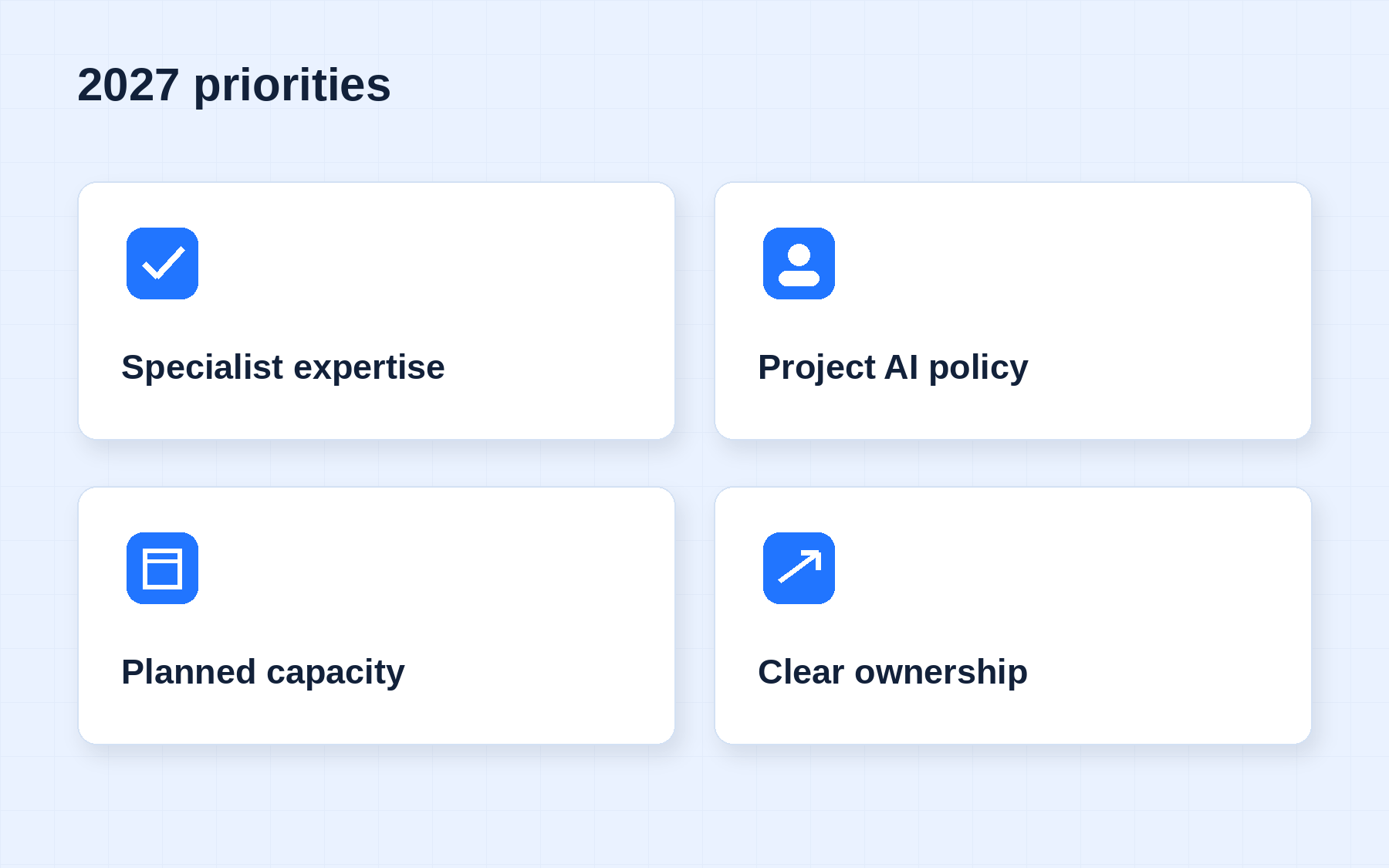
Looking ahead to 2027, we expect the strongest staff augmentation partnerships to place greater emphasis on specialist capability, project-specific working practices, and effective integration into the client’s team.
These are the priorities we would put at the center of a planning discussion.
A technology stack describes the environment. It does not fully describe the work.
Two engineers with experience in the same language may bring very different capabilities. One may be well suited to developing customer-facing APIs; another may have deeper experience with data processing, complex integrations, or operational reliability.
Requests for external support should therefore describe the challenge alongside the tools.
For example:
We need a backend engineer who can help us integrate a customer’s ERP system, handle synchronization failures, and work with our existing team on production support.
That gives a partner a meaningful basis for selecting candidates and gives the engineer a clearer understanding of the assignment.
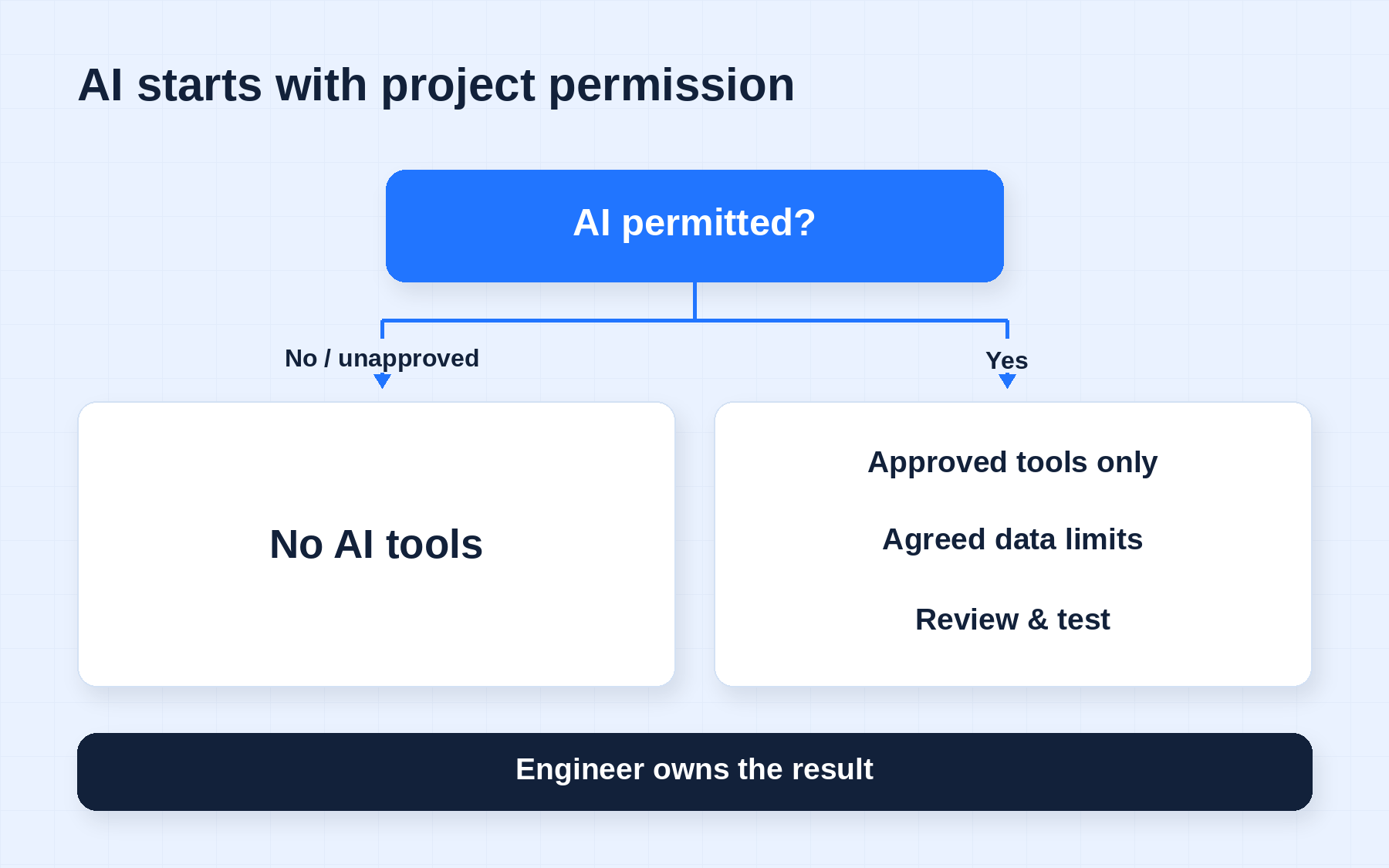
The first question is whether the project permits AI-assisted development.
Clients may restrict or prohibit AI tools because of confidentiality requirements, customer agreements, security policies, or the nature of the data involved. External engineers must be able to work effectively within those conditions.
Before an assignment begins, the client and engineering partner should establish whether AI tools are permitted and document any applicable restrictions. Until approval is clear, project work should proceed without AI tools.
Where AI use is prohibited, engineers must follow that requirement throughout the assignment. Candidate selection should confirm that they can independently understand the codebase, solve technical problems, and deliver the work without relying on AI assistance.
Where AI use is permitted, the next step is to agree on:
Within those boundaries, engineers should be able to evaluate generated code, identify incorrect assumptions, understand architectural implications, and verify changes through appropriate testing.
For 2027, our recommendation is to assess engineers against the project’s actual working conditions. Where AI is approved, evaluate how responsibly and effectively they use it. In every case, the engineer remains accountable for the work they submit.
Different phases of a product initiative need different levels of support.
An infrastructure specialist may be most valuable during assessment, implementation, and migration. A QA engineer may need to join early enough to shape acceptance criteria and test environments, well before the final release window.
This makes sequencing an important part of capacity planning. Bringing someone in too early can leave them waiting on dependencies. Bringing them in too late can compress the time available for understanding the system and resolving issues.
Build onboarding and knowledge transfer into the schedule. Both require time from the incoming engineer and your existing team.
Technical competence needs a working environment in which it can be applied.
We expect clients planning external support to look closely at how engineers enter an existing project: what context they receive, who answers questions, how they participate in reviews, and how progress becomes visible.
A structured start helps establish these expectations. It also gives both sides an early opportunity to confirm that the assignment and the engineer are well matched.
Staff augmentation is most useful when you can identify the gap it needs to address and provide the direction required to use that support effectively.
Your team understands the product and has a clear implementation plan, but a release requires more engineering work than it can complete within the available window.
External engineers can take on suitable parts of that work while your internal team continues to guide the product.
Before adding capacity, check whether tasks can progress independently and whether your team can support onboarding and code review. Those constraints determine how much additional work can move through the system.
A migration, integration, or new technical capability may require expertise that your team does not regularly need.
An external specialist can help assess options, implement the agreed approach, and prepare your team to operate the result.
Knowledge transfer should be part of the assignment from the beginning. Depending on the work, that may include implementation notes, operational procedures, paired sessions, and walkthroughs.
A permanent role may be necessary, while the recruitment process and product timetable move at different speeds.
External support can cover an agreed area of work during that period. To make the arrangement effective, define how responsibilities will change when the permanent engineer joins and what information needs to be transferred.
A core team may be developing the main product while an integration or platform improvement requires sustained attention.
Adding a suitably experienced engineer can make it possible to progress that initiative without repeatedly moving internal engineers between priorities.
This works best when the scope has a clear owner and dependencies with the core team are understood.
Across these scenarios, the benefits are practical: access to relevant expertise, flexibility in the duration of support, and the ability to retain product direction within your organization.
The financial case should reflect the full cost of the arrangement. Consider the engagement cost together with selection, onboarding, internal management, review, and the expected duration of the need.
A strong partner should help you turn a staffing request into a clear engineering requirement.
Before presenting candidates, they should ask about the product, the work to be completed, the team structure, and the responsibilities the engineer will assume.
Your evaluation should cover the following areas.
Ask how candidates are assessed against the work you need done.
For a complex integration, discuss API limitations, data consistency, failure handling, and support. For infrastructure work, explore deployment practices, observability, recovery, and migration planning.
You should be able to understand why a particular engineer is being recommended.
Agree on who sets priorities, reviews technical work, provides product context, and raises concerns.
In a staff augmentation arrangement, your organization needs sufficient internal leadership to guide the work. If you need a partner to own planning and delivery more broadly, discuss that explicitly so the engagement model reflects the responsibility.
Ask what needs to be ready before the engineer starts, who will support the first tasks, and how early progress will be reviewed.
A useful initial milestone is completing a contained task through the team’s actual development process. It provides evidence that access, context, communication, and delivery practices are working together.
Understand availability, working-hour overlap, engagement length, notice periods, and how changes to the assignment are handled.
Discuss continuity as well: how knowledge is documented, what happens if an engineer becomes unavailable, and how handover will work when the assignment ends.
Agree on what useful progress looks like for the role.
That could include completion of an integration milestone, ownership of a defined component, reliable delivery of agreed changes, or improved operational readiness.
Assess progress in context, including quality, collaboration, and the level of support required. Simple activity counts give an incomplete view of engineering contribution.
Before committing to external engineering support, review these planning areas with your product and technical leads.
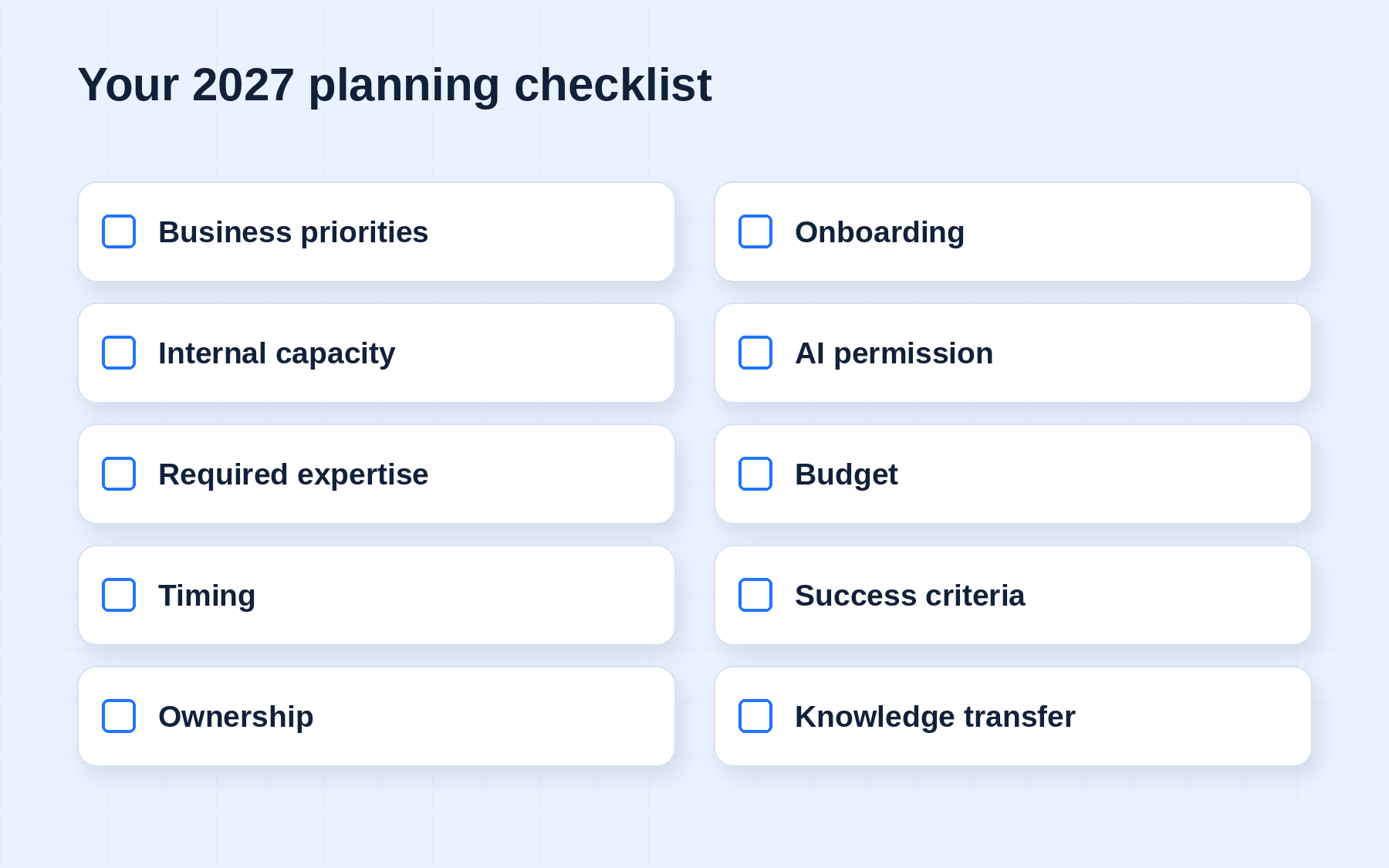
You do not need to finalize every staffing decision before January. You do need enough clarity to identify likely gaps, prepare for them, and decide when to act.
At Frontetica, we can help you translate your 2027 product plans into clear requirements for external engineering support.
The starting point is your roadmap, the capabilities already available in your team, and the responsibilities you need additional engineers to take on. From there, we can discuss suitable roles, relevant experience, timing, and how those engineers would work within your development process.
Whether you are preparing for a major release, planning an integration, or bringing specialist expertise into an existing product, a defined scope gives the collaboration a stronger foundation.
Planning your engineering team for 2027?
Talk to us about your plans for 2027. We’ll help you identify the expertise you need and how external engineers can support your team.