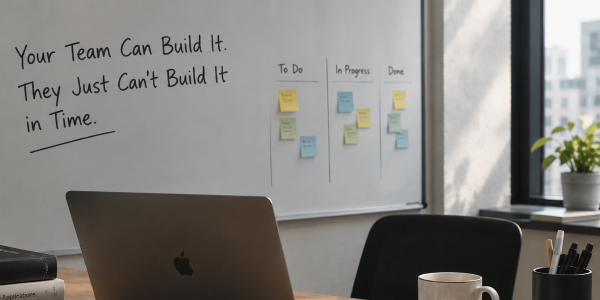
In boardrooms and sprint planning sessions alike, one assumption continues to dominate strategic hiring decisions: if we hire internally, we control quality. If we outsource, we trade speed for risk.
In 2026, that assumption is increasingly detached from reality.
The global technology market has shifted. Access to rare engineering expertise has become structurally constrained. Competition for senior developers, cloud architects, AI engineers, and security specialists is no longer local - it is global. At the same time, product cycles are accelerating, investor expectations are tightening, and technical complexity is rising.
In this environment, the real bottleneck is not budget.
It is access.
And the uncomfortable truth many CTOs are beginning to acknowledge is this: internal hiring is often slower, riskier, and more compromise-driven than high-quality outsourcing.
At Frontetica, we have seen this pattern repeatedly across scaling startups and mid-sized product companies. The question is no longer whether to hire internally or externally. The question is which model delivers impact faster - without sacrificing engineering integrity.
On paper, internal recruitment looks straightforward. Define the role. Publish the vacancy. Interview candidates. Make an offer. Onboard.
In practice, the timeline tells a different story.
For mid-to-senior roles in 2026, the average hiring cycle in competitive markets ranges from two to six months. For rare profiles - AI engineers, distributed systems architects, DevSecOps leads - it can be significantly longer.
And that timeline does not include:
From vacancy to meaningful contribution, the cycle can stretch well beyond a quarter.
During that time, roadmaps stall. Core engineers spend hours in interviews instead of building. Hiring panels experience fatigue. Standards fluctuate under delivery pressure.
Ironically, urgency often lowers the bar.
When product deadlines loom, companies make “good enough” hires. CVs look impressive. Interviews feel solid. But subtle gaps in product thinking, ownership, or architectural discipline reveal themselves months later.
The result is not just slower hiring - it is compounded technical risk.
One of the most persistent myths in software development is that ownership guarantees quality.
It does not.
What guarantees quality is access to the right expertise at the right time - and the ability to integrate it effectively into the product lifecycle.
In a mature outsourcing model, companies are not buying anonymous resources. They are gaining access to curated engineering ecosystems.
This distinction matters.
Specialised vendor teams often operate within focused technical domains: high-load backend systems, cloud-native architectures, complex data platforms, fintech compliance environments, AI integrations. Because they work across multiple projects within similar domains, their exposure is broader and more current than that of many in-house teams.
At Frontetica, our engineers frequently bring cross-project insight that internal teams, by definition, cannot accumulate within a single product environment. They have seen architectural patterns succeed - and fail - across industries.
This creates a higher density of relevant expertise.
Access replaces isolation.
This is where the discussion becomes uncomfortable.
Many organisations assume that internal hiring ensures higher quality because the process is “closer” to the company. In reality, internal recruitment pipelines are often narrower and more reactive than those of specialised engineering partners.
Consider the structural differences.
Internal hiring teams:
By contrast, a mature engineering partner:
In our experience at Frontetica, the filtering threshold must be stricter than that of typical in-house recruitment. Our reputation depends on every engineer embedded within a client team. A compromise hire does not remain internal - it becomes visible.
This structural accountability changes behaviour.
Vendor models that prioritise long-term partnerships cannot afford weak placements. The economic incentives align with quality.
Internal hiring metrics often focus on time-to-hire. But that metric alone obscures a more important one: time-to-impact.
Closing a vacancy does not create value. Contribution does.
Internal hires must:
Even strong engineers require time to become effective within a new context. In complex systems, that ramp-up can last months.
By contrast, high-quality outsourcing models are designed around accelerated integration.
Engineers are matched not only by stack but by domain exposure. They enter structured onboarding processes refined across multiple client engagements. Documentation expectations are clear. Communication cadences are established. Product ownership is emphasised from day one.
The result is not magic. It is operational maturity.
The critical path from assignment to impact shortens.
There is another cost few leadership teams measure: opportunity cost within the core team.
Every senior engineer participating in interviews is temporarily removed from product development. Every architectural discussion about a candidate is time not spent improving the system. Every hiring round increases cognitive load on already stretched technical leaders.
Over time, this creates a subtle but real productivity drain.
In high-growth environments, recruitment can become a parallel product in itself.
When we work with clients at Frontetica, one of the first measurable improvements is not just delivery velocity - it is the restored focus of their internal teams. Engineering leadership returns to architectural decisions instead of screening pipelines. Product managers refocus on strategy instead of staffing gaps.
Outsourcing, when structured properly, is not about replacing internal capacity. It is about protecting it.
The most acute pressure today is not for generalist developers. It is for rare specialists.
Cloud migration architects. AI integration engineers. Distributed systems experts. Cybersecurity specialists with regulatory experience. These professionals are scarce. They are globally mobile. They are heavily courted.
Competing head-to-head in this market requires salary escalation, employer branding investment, and long negotiation cycles. Even then, retention remains uncertain.
High-quality outsourcing models mitigate this constraint differently.
Instead of competing for ownership of a rare specialist, companies gain access to structured teams where expertise is distributed rather than concentrated in a single individual.
This reduces the “single-point-of-failure” risk - the bus factor that haunts many scaling startups.
Access becomes resilient.
The most persistent false dichotomy in hiring strategy is the belief that speed and quality trade against each other. In immature outsourcing models, this can be true. Rapid placement without technical discipline leads to poor outcomes.
But in mature models, speed is a byproduct of preparation.
Curated talent pools. Ongoing evaluation frameworks. Continuous performance feedback. Domain-aligned team structures.
At Frontetica, we do not recruit in response to client urgency. We build and maintain engineering capacity aligned with specific technological domains. When a partnership begins, the question is not “who is available?” but “who fits architecturally, culturally, and strategically?”
This distinction allows us to move faster without compromising standards.
Speed becomes structured, not reactive.
It is important to acknowledge that not all outsourcing delivers these outcomes.
Transactional body-leasing models - where any available developer is matched to any open task - perpetuate the stereotype that outsourcing sacrifices quality for cost.
The difference lies in maturity.
A high-quality outsourcing partner:
This is the model we have embraced at Frontetica from the outset. We do not optimise for short-term placements. We optimise for durable engineering relationships.
That philosophy changes hiring dynamics entirely.
Ultimately, the hesitation many organisations feel toward outsourcing stems from control. Ownership feels safer than access. But in 2026, control does not derive from employment contracts. It derives from process clarity, architectural governance, documentation discipline, and accountability frameworks.
A well-integrated external engineer operating within transparent systems is often more predictable than an isolated internal hire operating without structured oversight.
Control is systemic, not contractual.
The companies that will scale most effectively in the coming years are not those that insist on owning every engineer. They are those that optimise access to expertise, minimise hiring friction, and structure partnerships around long-term product impact.
Internal hiring will always have its place. Core leadership, cultural anchors, and architectural stewards belong within the organisation.
But surrounding that core with high-quality, embedded external expertise is no longer a compromise.
It is a strategic advantage.
At Frontetica, we have seen firsthand how access-driven engineering models reduce time-to-impact, elevate technical standards, and protect internal focus. The goal is not to replace hiring - it is to remove its bottlenecks.
In a market where speed matters and quality determines survival, the real question is no longer “should we outsource?”
It is “how quickly can we access the right expertise - without lowering the bar?”
And increasingly, the answer lies not in the recruitment pipeline, but in the maturity of the partnership.
At Frontetica, we do not position outsourcing as a universal solution. Nor do we believe that internal hiring should be replaced.
We believe in a balanced approach.
A strong internal core team, complemented by carefully embedded external engineers who share responsibility for architecture, product outcomes, and long-term sustainability. Not contractors detached from context - but integrated contributors aligned with business goals.
Over the years, we have refined our model around this principle: strict technical selection, product-oriented thinking, and long-term collaboration over transactional placements. The result is not simply faster scaling, but more predictable and resilient growth.
If this approach resonates with the challenges you are facing, we would be glad to discuss what a mature, partnership-driven model could look like for your product and team.